7.29.2010

Encore! at BCW and Lynn Duryea's fantastic surfaces


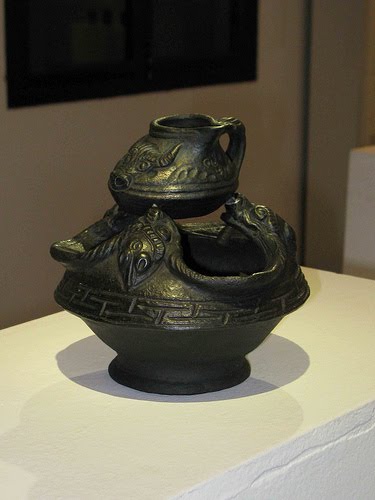
I will be participating in Baltimore Clayworks show Encore! Always glad to be showing with such a great list of people. Check it out if your in the area. The image above is a detail shot of a Lynn Duryea sculpture. Beyond teaching at my alma mater, Appalachian State University, she is a fine person and a great artist. She is a founding member of Watershed and a University of Florida Alum.(I have shamelessly promoted both my alma maters in this post. Whoppeee!) The surfaces on her work have a wonderful patina.

For more on her work Click Here.

Encore!

August 14th – September 25th, 2010
Opening: August 14th, 6-8
Baltimore Clayworks is proud to host Encore! an exhibition celebrating thirty years of bringing clay to the Baltimore community and beyond. This exhibition runs August 14th – September 25th, 2010 with an opening reception on Saturday, August 14th, from 6 to 8 pm. Admission is free.

This exhibition will feature artists who have been an integral part of our legacy and advanced our mission of showcasing outstanding ceramic art. They are part of an elite group who have supported and strengthened our artist-centered community that promotes the best of established and emerging ceramic art.

Invited Artists: Doug Baldwin (MT), Jason Briggs (TN), Ben Carter (FL), Doug Casebeer (CO), Linda Christianson (MN), Richard Cleaver (MD), Michael Corney (NM), Patrick Coughlin begin_of_the_skype_highlighting     end_of_the_skype_highlighting (NY), Kevin Crowe (VA), Malcolm Davis (DC), Bruce Dehnert (NJ), Paul Dresang (IL), Lynn Duryea (NC), Melody Ellis (IL), Shanna Fliegel (MT), Debra Fritts (GA), Krista Grecco (GA), Giselle Hicks (NY), Rick Hirsh (NY), Bryan Hopkins (NY), Nick Joerling (NC), Peter Karner (CO), Reena Kashyap (NY), Matt Kelleher (NC), Kristen Kieffer (MA), Jeff Kleckner (PA), Maren Kloppmann (MN), Stephanie Lanter (KS), HeeSeung Lee (PA), Suze Lindsay (NC), David MacDonald (NY), Linda McFarling (NC), Kent McLaughlin (NC), Laura Jean McLaughlin (PA), Brooke Noble (NY), Richard Notkin (MT), Jill Oberman (IL), Lisa Orr (TX), Sarah Panzarella (NY), Brenda Quinn (NY), Jeremy Randall (NY), Allison Rednour (OH), Justin Rothshank (IN), Frank Saliani (NY), Brad Schweiger (OH), Virginia Scotchie (SC), Andy Shaw (LA), Nancy Selvin (CA), Eric Seritella (NY), Tim Sherman (MD), Debbie Sigel (PA), Linda Sikora (NY), Gertrude Smith (NC), Bill Stewart (NY), Shoko Teruyama (NC), Bill Van Gilder (MD).

7.28.2010

A trip through Tianzifang


Tianzifang is a hip shopping/dining district that sits behind The Pottery Workshop. Its maze like alley ways are a throw back to early 1900's Shanghai living. Within the last ten years the area has shifted from residences to shops. The pictures above show the crowds meandering around on rare sunny day.

There was a great article published by the Beijing Review on the history of the area and the architecture. Here is a snippet that explains the Shikumen style. For the complete article click here.
"Wu started looking at small stone houses called shikumen, or "stone gate." These two- and three-story houses, densely packed in narrow lanes, reflect typical Shanghai architectural style.

The shikumen are small but have a long history, having been constructed by factory staff and middle- and lower-class workers in the 1920s. Their architectural style and primitive nature had remained almost completely intact. More and more tourists were attracted by these "living museums" of old Shanghai culture, making it an attractive area for investment.

7.18.2010

Nixi Pottery from Yunnan Provence


My recent trip to Jingdezhen coincided with an exhibition of Nixi pottery from the Yunnan Provence (Tibet). There were 10 Tibetan artists who accompanied NYC based ceramicist Kathy Erteman (Click Here for Kathy's site)  to Jingdezhen for a three week residency. She has been working with the group to enrich the production and marketing of the indigenous pottery of Nixi.

While in Jindezhen they used an electric wheel and modern metal trim tools for the first time. I went to visit them in the PWS Two Chimneys education center while they were working. It was funny to see them crowded around the wheels watching each other work. I take for granted that electric wheels are not universal for production potters. They were as excited as children at Christmas as they took turns practicing.
Right now they handbuild their forms and carve the details by hand.

The work on display was a rich black terracotta that was shaped into teapots, jars, and vases. The color comes from the open pit firing they use to finish their work. The forms and surfaces are reminiscent of the Maria Martinez lineage of potters that work in New Mexico. Its amazing that two cultures that had no connection share similar aesthetic preferences.

My favorite pots were the elevated side handle pitcher and lidded teapot. These two-part pieces include a container for holding hot coals and a suspended pouring vessel used to serve butter tea. The pouring vessels rest on three arms that rise above the rim of the larger pot. They are a nice mix of  negative and positive space. Some of the pots had pieces of white ceramics inlaid into their surfaces. These patterns of inlay created a sharp contrast to the pitch black clay body. The first two pictures above are these forms.

A quick internet search finds more information on this style of pottery. Click here to see a slide show.

7.15.2010

Why should you donate to that art auction?


 Its that time of year again. The days are long, the grass smells good after a fresh cut, and the auctioneers are pounding their gavels raising money for various organizations around the country. I have been honored with participating in auctions at many levels from nationally established art centers to the local diabetes foundation. Every time I am asked I have to think about what pieces will best serve the needs of the organization.

Do I play it safe and donate something that I know will sell therefore raising easy money for the organization? Do I pick the high-end pot that looks great in an ad but might sell barely above the reserve if participation isn't stellar? Do I send work that could be shown in other exhibitions garnering more publicity? Do I make work for that specific auction, or send work that I make regularly? Do I decline because it is one more commitment to add to an already busy show schedule? Would the deductions off my taxes benefit me in the long run? All these questions circulate through my head when I receive the invitations in the mail.

The simple answer to most of these questions is that I send what looks the best relative to what I have available. I try to provide the organization with work that best represents my current body of work. Sometimes this means I send work that could be shown in other venues providing more financial stability and publicity. I have found that the benefits I receive within the community far out weigh the financial loss. Its good to remember that auctions are about donating and supporting the organizations that you believe in.

Occasionally financial gain does come from a donation. Last year a pitcher I donated was caught in a bidding war between two participants. The original was sold for almost twice the retail price. The person who didn't win the bid ordered another pitcher from me shortly after auction. This was the perfect scenario. The organization made money, I made money and both customers where happy with the pots they bought.

I will be participating in the Anderson Ranch Auction this year. To see what is available for bidding please click here. There are some great pieces up for bidding this year. Check out these pieces by Josh Deweese, and Seth Green.


7.08.2010

Fan Jian Jing- Fake is still pretty nice.


The Fan Jian Jing is a maze of back alleys in downtown Jingdezhen where the business of faking Chinese antiquities has been perfected. Ceramics, wood, scrolls, stamps, furniture, you name it, they fake it. Some of them are so bad that you can tell from 10 ft away that they are not real. At times though, they are convincing enough that a pottery geek can still get excited.

The pictures above are Song-Jian Ware (black tea bowl), Ming style replicas (blue, red, yellow), Song-Longquan ware (celedon pots on the metal shelves), and Tang dynasty San Cai ware. The last images are of the methods they use to "age" the pots. Mixtures of dyes and iron bearing-dirt are rubbed into the surface of the pots. The craftspeople are very open about this whole process. You can see men rubbing pots with broken kiln shelves to intentionally chip their edges.

As a one time pottery snob I was surprised that this process of fakery doesn't bother me. It meets a simple supply/demand curve. People love these pots. I love these pots. After seeing so many of them in books throughout the years it was great to pick up the 3-d versions. On some level I could relate more the fake 3d versions than the 2d ones I've looked at over and over. I can imagine these fake antique markets are a huge problem for museums. They must run across many collections that have more than a few fakes in their official lists.

Pier One, Pottery Barn, and Walmart could be stocking their shelves with these knock-offs instead of the hodgepodge of cheap contemporary mass produced pottery. If we are going to engage in the thrill/downfall of a global economy, why not educate people as we go? Think about a time were every consumer could recognize a Song dynasty glaze because a antique replica was the featured image on the Walmart weekly coupon mailer.

I got to see many replicas of the five spouted Longquan Jar from the Song Dynasty, 960 AD-1279AD. I believe this famous form can be linked to the inspiration for many potters who are currently making flower bricks/ tulipieres. Before I leave China I have to get one of these. Actually, Ill probably get a bunch. I would love to have a Tang Horse and a Song Lotus petal bowl to round out the collection.

Here is one of the original Longquan jars that I recently saw at the Shanghai Museum.


.

7.05.2010

Michael Jackson> James Brown> Marvin Gaye> Elvis> Ray Charles...

There are so many unexpected joys that come from living in a foreign country. One of them happened today when I realized that my Chinese coworkers didn't know any American music before Michael Jackson. Its the first time I have ever mentioned the name Elvis and got a completely blank stare. I couldnt stop laughing. It makes sense when you think about the limited role western culture had in China from 1949 on.

The later part of the night I spent playing the music that influenced the American music generation before it. It started with them playing an American born Chinese singer that was mimicking Michael Jackson's acapella rifts. I explained that he was copying Jackson who got it from James Brown. I tried to explain that Jackson also patterned his dancing style after Brown's ( in honor of the Godfather of Soul I'm posting my favorite youtube video of him dancing.)

From there I played them early Ray Charles. Next came Elvis who covered Charles' " I got a Woman" and rose to fame by copying African American music. Then I had to throw in Marvin Gaye to explain what the Motown sound was. Even with my limited understanding of history I could link back 60 years of American music.

Tomorrow I'm going to introduce them to Johnny Cash by way of the rivalry he had with Elvis. Then I can explain the June Carter Cash and the Carter family, which is a great segue way into the music from my region of the world, bluegrass.

7.02.2010

Lao Chang Decorators


I stopped to watch this man decorate for quite a while. His traditional blue and white porcelain represents the continuation of a tradition that started in Jingdezhen in the fourteenth century. He is one of many decorators working in this style at the Lao Chang ceramics factory. By the speed he was going I would say he spends 1 1/2 to 2 days decorating the larger pots. The decoration was composed of hundreds of delicate brush strokes.

A quick blurb from Wikipedia on the subject:
"In the early fourteenth century mass-production of fine, translucent, blue and white porcelain started at Jingdezhen, sometimes called the porcelain capital of China. Chinese blue and white porcelain was once-fired: after the porcelain body was dried, decorated with refined cobalt-blue pigment mixed with water and applied using a brush, coated with a clear glaze and fired at high temperature. Blue and white porcelain made at Jingdezhen probably reached the height of its technical excellence during the reign of the Kangxi emperor of the Qing Dynasty (reigned 1661 to 1722)."


As you can see from the second picture, his shop had no advertisements, no signs, nothing to draw notice to his fine brush working skills. The quality of his work was the only thing that separated him from the studio next door. Most studios that I saw were dimly lit 10 x10 ft spaces, with no AC, and concrete floors.The "showrooms" in this area consisted of pots loosely arranged around the studio.


The decorators have the pots delivered to their studios on carts that are pulled through the alleys by hand. The picture above demonstrates the precarious nature of this form of transportation. This specific picture is of a pot that has been decorated with over glaze. They are taking it to one of the numerous public kilns to be fired.

Each step in the ceramic process provides room for a micro-economic climate to develop. Every pot is touched many times by people who are trying to compete to do the same jobs faster than their competitors. An interesting PHD dissertation could be the study of capitalism and competition in these small workshops.

7.01.2010

Team throwing at Lao Chang Ceramics Factory


I spent one day walking around the Lao Chang Ceramics Factory in Jingdezhen. The word "factory" is used loosely here. The factories are actually large areas of town devoted to producing specific types of pottery. Some studios are slip casters, some are throwers, some are decorators. Each factory has hundreds of studios lining the streets. 

These guys were on a street where everyone was throwing large pots. They aren't the largest pots thrown in Jingdezhen but they were still pretty big (about 2 1/2 feet tall.) It was amazing to see how the two guys worked together to center and pull the walls. One touched the clay while the other was pushing on the outside of his hands. The wheel stayed at a constant speed as they moved effortlessly through the motions. They worked very quickly spending about 10 minutes on each pot. After the piece was finished a third guy took it off the wheel to place it outside under a drying tent. A forth guy handed an already wedged piece to the thrower and the process started over.