Showing posts with label jingdezhen. Show all posts

11.21.2010

Pots as far as the eye can see-Pt.2


It is very common to see carts of pots being pulled through the streets of Jingdezhen. They might be going from the pottery to the decorators, or from the decorators to the kilns. There are large gas car kilns spread through out the individual factories. (By factories I mean the pottery producing neighborhoods that have grown out of old state run factories. It is common to see families living above their workshops so these factories become small villages within the larger city.) The community kilns are rented by the cubic centimeter to individual artists/shops. After the pots are fired they are unloaded and wrapped in grass bundles to be transported to other parts of the city to sell.

One advantage of large scale commercial production is that glazes have been tested and retested to fit the clay bodies perfectly. You can buy a pristine Celedon that doesn't craze on the local porcelain. Copper reds, rutile blues, and crystalline matts are at your disposal for ridiculously cheap prices. The glazes are sold premixed in liquid form so that all you must do is apply them. If you wanted to be extra lazy you can hire a glaze person to come and glaze them for you. This highly specified division of labor allows international artists to come to Jingdezhen with designs and have them realized in a relatively small amount of time.

Pots as far as the eye can see-Pt.1


I am fascinated by the shear number of pots that are made in Jingdezhen, P.R.C. The unofficial numbers are that 40% of the local economy is ceramic based. (Thats roughly 400,000 people!) Some of these people are potters, some are decorators, some fire kilns, some process clay, and others are in the packing/shipping portion of the economy. The division of labor is very specific with each step of the process being handled by separate groups of workers. (To see an older post of throwers click here. To see decorators click here) While people hand throw a variety of forms most of the pots are slip cast. The images above are of a mold maker and a pair of slip casters. The day we visited pots were lined up down the edge of the train tracks. A train came through which surprisingly didn't cause enough vibrations to knock the pots over.

While the parents work the smaller children attend an open-air Kindergarden located on the same street. I had a great time playing peek-a-boo with the kids. The kids that look blurry in this image where my partners in crime. They would duck under their desks and giggle when I held my camera up. I had to hide behind the edge of the building so they would come out again. The teacher didn't seem to mind so I kept it up for about five minutes before we went on to see the rest of the potteries.

11.16.2010

The Patterned Streets of Jingdezhen


On a recent trip to Jingdezhen I found myself photographing mundane objects like walls, gates, and windows. These everyday architectural fixtures are filled with layers of pattern that continually interest me. After hours of carefully painting pots I find it comforting to look at the irregular erosion on a brick wall. It feels refreshing because the surfaces are not intentional. They are biproducts of many variables acting upon each other over a long period of time. I try to replicate this aged surface in the way I dip my pots in thin white slip. When the application is just right you can see a red halo on the edge of handles and slip trailed lines. This type of ghost line is something I'm trying to master in my own work.

11.01.2010

Turkish Ceramics at PWSSH and Jingdezhen Ceramic Fair


The Pottery Workshop will been hosting an exhibition of contemporary Turkish ceramics for the month of November. The thirty four artists were chosen by Zehra Cobanli, the dean of the art faculty at Anadolu University, Iskeshir, Turkey. The work in the exhibition represents a large cross section of styles and techniques including saggar firing, salt firing, intricate slip casting, and traditional wheel throwing. Its great to see how much of this work relates to Turkish ceramic history.

I had the pleasure of hosting Zehra, Lale Demir Oransay, and Onur Mustak Cobanli for a week long trip through Jingdezhen and Shanghai. Our visit to Jingdezhen coincided with the International Ceramics Fair. The exhibits were somewhat lame from an art perspective but it was an interesting cultural event. Their were elaborate opening/closing ceremonies, a ceramic fashion show, and every kind of blue and white porcelain you could imagine. It was presented like a trade show with hundreds of individual booths selling pots. There was one international exhibit that featured work from international artists, including a few sweet pots from American potter Mike Jabbur.


Our tour culminated with the opening of the exhibition in Shanghai. The reception was packed and we had many distinguished guests from the local Turkish community. The Consul General of Turkey, Murat Ulku, came and gave a nice talk about China/Turkey relations. Our director Caroline Cheng also spoke about silk road trade connections and their affect on ceramic design.


I hope to do a series of posts on the areas we toured in the near future. My favorites were the Longua Temple in Shanghai and the Sanbao ceramic village outside of Jingdezhen. I took hundreds of pictures so they will trickle out on the blog as a sort through them.

8.04.2010

Garth Johnson's Extreme Craft & Magic Jing Bling


I just discovered that I never posted these images of the electroplated wonderfulness from Jingdezhen. The image above is one of Garth Johnson's teapots. Although this process is a family secret of one of Jingdezhen's local studios, Garth explained that the process is most likely electroplating of some type. You can take any object that is nonporous and have it covered with a completely even coat of gold or silver. When I saw the shiny pots peaking out from below the cloth I wanted to hold them like Golem holding the ring. Its Jingdezhen's version of bling.

If your not familiar with Garth's work you can check it out here. In Jingdezhen he was using western images to tell Chinese allegories. I enjoyed spending time with he and his wife Claire while they were working in the studio and visiting China. He also writes a fantastic blog called Extreme Craft. Check it out here. Its a must read for any craft fan. He has the best slogan for any website " A compendium of art masquerading as craft, craft masquerading as art & craft extending its middle finger."

7.18.2010

Nixi Pottery from Yunnan Provence


My recent trip to Jingdezhen coincided with an exhibition of Nixi pottery from the Yunnan Provence (Tibet). There were 10 Tibetan artists who accompanied NYC based ceramicist Kathy Erteman (Click Here for Kathy's site)  to Jingdezhen for a three week residency. She has been working with the group to enrich the production and marketing of the indigenous pottery of Nixi.

While in Jindezhen they used an electric wheel and modern metal trim tools for the first time. I went to visit them in the PWS Two Chimneys education center while they were working. It was funny to see them crowded around the wheels watching each other work. I take for granted that electric wheels are not universal for production potters. They were as excited as children at Christmas as they took turns practicing.
Right now they handbuild their forms and carve the details by hand.

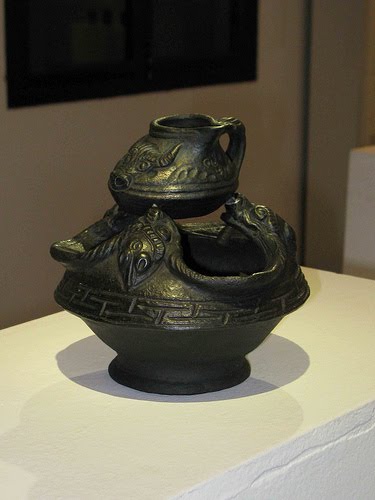
The work on display was a rich black terracotta that was shaped into teapots, jars, and vases. The color comes from the open pit firing they use to finish their work. The forms and surfaces are reminiscent of the Maria Martinez lineage of potters that work in New Mexico. Its amazing that two cultures that had no connection share similar aesthetic preferences.

My favorite pots were the elevated side handle pitcher and lidded teapot. These two-part pieces include a container for holding hot coals and a suspended pouring vessel used to serve butter tea. The pouring vessels rest on three arms that rise above the rim of the larger pot. They are a nice mix of  negative and positive space. Some of the pots had pieces of white ceramics inlaid into their surfaces. These patterns of inlay created a sharp contrast to the pitch black clay body. The first two pictures above are these forms.

A quick internet search finds more information on this style of pottery. Click here to see a slide show.

7.08.2010

Fan Jian Jing- Fake is still pretty nice.


The Fan Jian Jing is a maze of back alleys in downtown Jingdezhen where the business of faking Chinese antiquities has been perfected. Ceramics, wood, scrolls, stamps, furniture, you name it, they fake it. Some of them are so bad that you can tell from 10 ft away that they are not real. At times though, they are convincing enough that a pottery geek can still get excited.

The pictures above are Song-Jian Ware (black tea bowl), Ming style replicas (blue, red, yellow), Song-Longquan ware (celedon pots on the metal shelves), and Tang dynasty San Cai ware. The last images are of the methods they use to "age" the pots. Mixtures of dyes and iron bearing-dirt are rubbed into the surface of the pots. The craftspeople are very open about this whole process. You can see men rubbing pots with broken kiln shelves to intentionally chip their edges.

As a one time pottery snob I was surprised that this process of fakery doesn't bother me. It meets a simple supply/demand curve. People love these pots. I love these pots. After seeing so many of them in books throughout the years it was great to pick up the 3-d versions. On some level I could relate more the fake 3d versions than the 2d ones I've looked at over and over. I can imagine these fake antique markets are a huge problem for museums. They must run across many collections that have more than a few fakes in their official lists.

Pier One, Pottery Barn, and Walmart could be stocking their shelves with these knock-offs instead of the hodgepodge of cheap contemporary mass produced pottery. If we are going to engage in the thrill/downfall of a global economy, why not educate people as we go? Think about a time were every consumer could recognize a Song dynasty glaze because a antique replica was the featured image on the Walmart weekly coupon mailer.

I got to see many replicas of the five spouted Longquan Jar from the Song Dynasty, 960 AD-1279AD. I believe this famous form can be linked to the inspiration for many potters who are currently making flower bricks/ tulipieres. Before I leave China I have to get one of these. Actually, Ill probably get a bunch. I would love to have a Tang Horse and a Song Lotus petal bowl to round out the collection.

Here is one of the original Longquan jars that I recently saw at the Shanghai Museum.


.

7.02.2010

Lao Chang Decorators


I stopped to watch this man decorate for quite a while. His traditional blue and white porcelain represents the continuation of a tradition that started in Jingdezhen in the fourteenth century. He is one of many decorators working in this style at the Lao Chang ceramics factory. By the speed he was going I would say he spends 1 1/2 to 2 days decorating the larger pots. The decoration was composed of hundreds of delicate brush strokes.

A quick blurb from Wikipedia on the subject:
"In the early fourteenth century mass-production of fine, translucent, blue and white porcelain started at Jingdezhen, sometimes called the porcelain capital of China. Chinese blue and white porcelain was once-fired: after the porcelain body was dried, decorated with refined cobalt-blue pigment mixed with water and applied using a brush, coated with a clear glaze and fired at high temperature. Blue and white porcelain made at Jingdezhen probably reached the height of its technical excellence during the reign of the Kangxi emperor of the Qing Dynasty (reigned 1661 to 1722)."


As you can see from the second picture, his shop had no advertisements, no signs, nothing to draw notice to his fine brush working skills. The quality of his work was the only thing that separated him from the studio next door. Most studios that I saw were dimly lit 10 x10 ft spaces, with no AC, and concrete floors.The "showrooms" in this area consisted of pots loosely arranged around the studio.


The decorators have the pots delivered to their studios on carts that are pulled through the alleys by hand. The picture above demonstrates the precarious nature of this form of transportation. This specific picture is of a pot that has been decorated with over glaze. They are taking it to one of the numerous public kilns to be fired.

Each step in the ceramic process provides room for a micro-economic climate to develop. Every pot is touched many times by people who are trying to compete to do the same jobs faster than their competitors. An interesting PHD dissertation could be the study of capitalism and competition in these small workshops.

7.01.2010

Team throwing at Lao Chang Ceramics Factory


I spent one day walking around the Lao Chang Ceramics Factory in Jingdezhen. The word "factory" is used loosely here. The factories are actually large areas of town devoted to producing specific types of pottery. Some studios are slip casters, some are throwers, some are decorators. Each factory has hundreds of studios lining the streets. 

These guys were on a street where everyone was throwing large pots. They aren't the largest pots thrown in Jingdezhen but they were still pretty big (about 2 1/2 feet tall.) It was amazing to see how the two guys worked together to center and pull the walls. One touched the clay while the other was pushing on the outside of his hands. The wheel stayed at a constant speed as they moved effortlessly through the motions. They worked very quickly spending about 10 minutes on each pot. After the piece was finished a third guy took it off the wheel to place it outside under a drying tent. A forth guy handed an already wedged piece to the thrower and the process started over.